
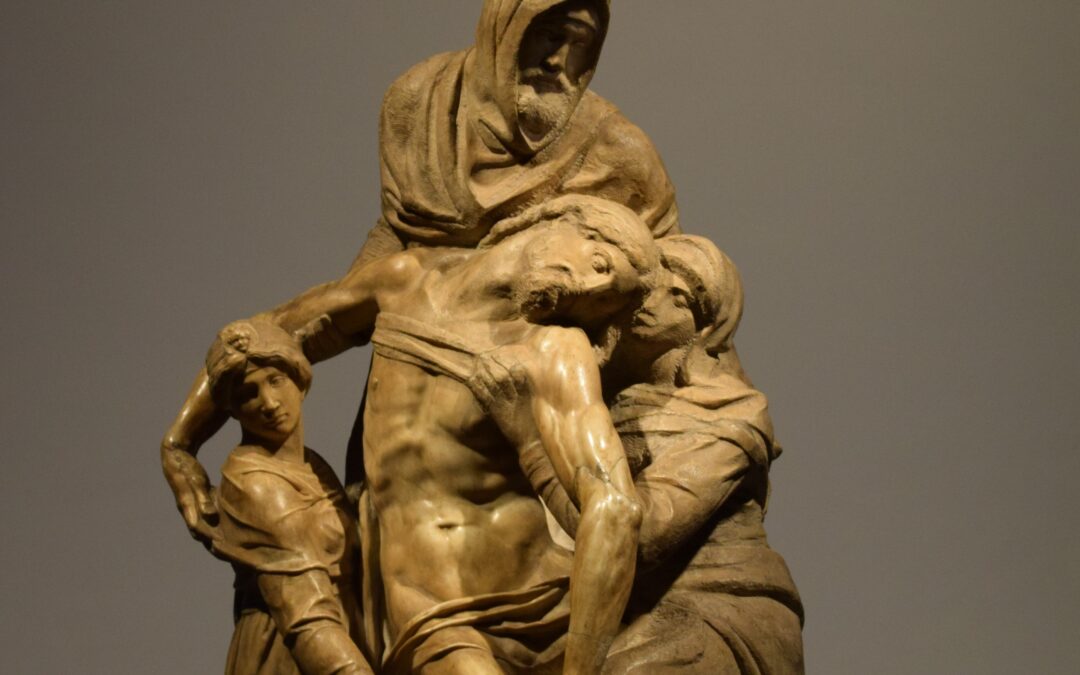
My new book of poetry, Chora, is scheduled for publication this fall as part of Cascade Press’s Poiema series. The collection includes, “The Florentine Pietà,” which describes an unfinished sculpture by Michelangelo Buonarroti now displayed in Florence’s Duomo Museum. Not as well-known as his Pietà in the Vatican, this marble sculpture—alternately called “The Deposition” or “The Bandini Pietà”—includes not only the dead Christ and his grieving mother but Mary Magdalene and a hooded figure said to be Nicodemus, the Pharisee who aided in Jesus’s burial. Nicodemus’s face is considered Michelangelo’s self-portrait in stone.
Dissatisfied with the still unfinished sculpture after eight years of work, Michelangelo took a hammer to it, badly damaging the marble limbs. His reasons for doing so are the cause of much speculation, though Giorgio Vasari suggests defects in the stone had plagued the sculptor all along. The figures were partially restored under Francesco Bandini’s direction with less than satisfactory results, though the majesty of Michelangelo’s original—if thwarted—vision remains.
The Florentine Pietà
The Florentine Pietà
(Museo dell’Opera del Duomo, Florence)
To have left it not only unfinished
but dismembered beyond all repair—
Christ’s leg missing, arm fragments spliced,
the Magdalene since badly completed—
may have been a fault of the marble
lately recognized, some defective vein
that thwarted his efforts to render
this summit of human grief and kindled
the fury with which he hammered the stone—
eight years labor lost in one night of rage.
Seeing it, I shudder at the weight
he assumed in quarrying beauty
from chasms of despair. The blank-eyed Virgin
embraces her son’s muscular mortality,
resting his head aslant on her cheek
with such tenderness the rock seems to weep,
while cowled Nicodemus bends toward both
with half-hewn hands, struggling to sound
the fathomless motives of a hidden God
in the moment of Christ’s deposition.
Still rough-edged, the unrealized mourners—
more so than the mourned—look strangely blurred
as if endowed with energies past
the strength of the stone to contain. Almost
animate, the carved forms quiver
in the dim light of the gallery
while the Pharisee’s downcast face—
the sculptor’s self-portrait—broods on the body
in which he must now inter what remains
of an eviscerated hope.
Was this, then, the fatal conceit—
contrived at Michelangelo’s hand—
that drove him to destroy his work,
lest the unrelieved strain of suffering
cause the marble itself to explode?