
Latest Book
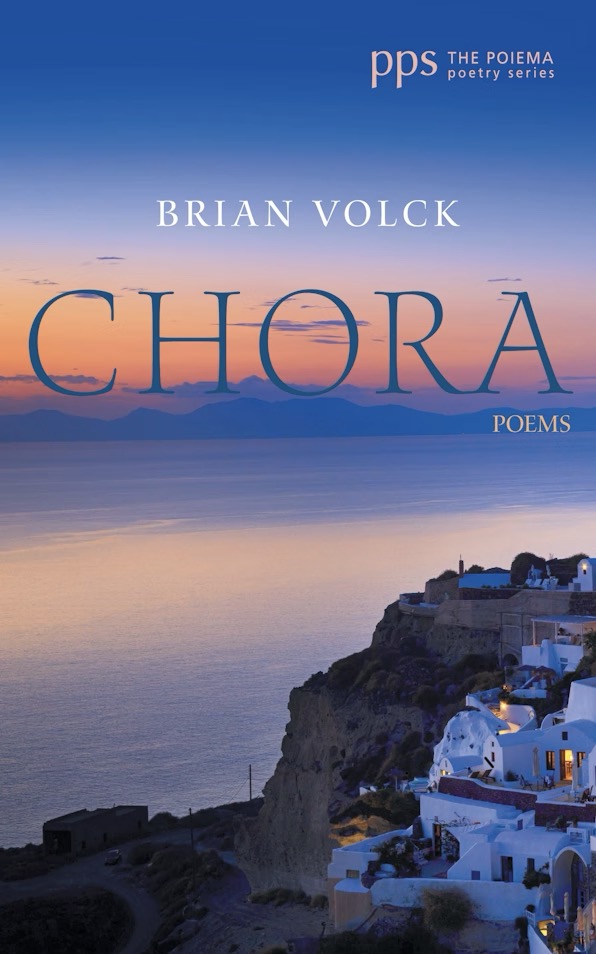
Chora: Poems
Available now from:
Cascade Press
Amazon
Bookshop.org
Your local bookstore
Book Description
Rich in close observation and sensory detail, these poems attend to the mysteries of living as finite creatures in a wondrous world. For Brian Volck, such mysteries aren’t puzzles to be solved but challenges that demand better questions. How does one act compassionately toward one’s neighbors? Toward creation? How does one cultivate practices of hospitality and attention? What do words, art, and natural beauty demand of us? How does one reckon with mortality? And ultimately, what is required to act justly, love mercy, and walk humbly with the unfathomable mystery of God?
Praise for Chora
“Once again Brian Volck works his magic with Chora, carving words as he so deftly does into the wide margin of silence where they have room to stir us in the heart’s hidden caverns of listening. Here are poems of a witness that come from a long and generous looking.”
—Mark S. Burrows, co-author of You Are the Future: Living the Questions with Rainer Maria Rilke
“Brian Volck’s Chora features a speaker in uncomfortable places who is still open to wonder and awe. These smart, heartfelt poems lay bare the experience of Parkinson’s disease’s slow pull, and reckon with racial injustice, challenging white liberals who merely say, ‘Somebody should do something.’ With the eye of Gerard Manley Hopkins and the spirit of Wendell Berry and Lazarus, this book will startle and hearten you.”
—Lisa Ampleman, author of Mom in Space
“
Praise for Chora, continued
“In Chora, Brian Volck, who is both a doctor and a poet, ‘beckons’ his ‘unmoored’ thoughts back to a ‘body astonished to find itself / at home in a world of sensible things.’ . . . When a dear friend who had ‘no use for deities / cried, O my God, O my / God as they viewed the sun’s corona during an eclipse,’ Volck sees how a ‘narrow crescent / of emerging sun / relit the spellbound world.’ The poems in Chora seek to do just that: bring a world already ‘spellbound’ into focus so we may be astonished once again.”
—Robert Cording, author of In the Unwalled City
“The free verse of these short, rich poems holds its shape like dew, luminous and momentary. Beautifully cadenced verses seem, like Psalms, to want to be sung. Or at least given voice. Read these poems aloud. With gratitude. They offer refuge from storms that threaten to shake our ‘inmost calm’ and a source of hope, hard-won and generously wrought.”
—Marilyn McEntyre, author of Midwinter Light
“The unifying vision of Brian Volck’s Chora is a prayer; it is also mine: that ‘every turn we take / may prove a turning toward.’ Having read widely and deeply, having pored over much, having loved generously, having kept his eyes, his mind, and his heart open to all that he happens upon, Volck has come to witness within the wild mix of persons, places, and things a village—a Χόρα—in which I, too, would be very pleased to dwell, now and ever.”
—Scott Cairns, author of Slow Pilgrim
“Brian Volck’s Chora is a brilliant collection of poems, covering all seasons, often month by month, and so many splendid locations, from Baltimore and Cincinnati to the American West—especially among the Navajo nation—to Europe and Greece. He’s a deeply philosophical thinker, versed in the Hebrew scriptures and especially in the Gospels, offering one new insight after another. Then too there is the way he keeps returning, with the help of his wife and muse, to the beauty right there before him, as women so often see it first. Yes, and there is of course, being the physician, pediatrician, and teacher that he is, the reality of human suffering and the deep loss of our loved ones. Page after page offers us another insight, a new sense of reality that only the poem can offer: the elegiac, yes, but then too the bounty of blessings we have been given.”
—Paul Mariani, University Professor of English, Emeritus, Boston College
“Brian Volck’s new collection, Chora, takes its name from a Greek word designating an actual location or a general space of presence. Each poem is itself a place of mystery and meaning, where we sense ‘the desire for all things / to illumine the darkness with glory.’ Never resorting to easy pieties, Volck instead honors what has been ‘gravely harmed but not unhallowed.’ These poems of praise and lament celebrate the broken and the beautiful.”
—Margaret Mackinnon, author of The Invented Child
“Brian Volck’s poems take us to the ‘thin places’ where matter and spirit, temporal and eternal, meet. In those spaces he finds the possibility of joy and healing, but only when suffering is embraced, and our need for conversion is recognized. Speaking from the midst of his own struggles, he asks not for pity but for companionship: ‘Help me live / into this brokenness as you live / into yours.’ And that is precisely what his poems offer us: the companionship of a fellow pilgrim.”
—Gregory Wolfe, author of Beauty Will Save the World
Excerpts from an interview with Brian
What reading audience would be drawn to this book, your second collection of poetry?
I hope Chora will interest readers who are open to matters of the spirit and heart, who aren’t afraid to ask questions without an immediate answer. These poems are my means of paying attention to the world, reaching out to created things in acts of witness and wonder. If you have a body and an inner life, if you’ve ever been astonished by what you see when you slow down and look, if you’ve ever wrestled with something so beautiful and mysterious it left you forever changed, there’s something here for you.
Why is your new book titled Chora?
I love the word for its many rich meanings. Chora, sometimes rendered as Khōra, is a Greek word for a location or place, typically a town or countryside. In classical philosophy, Khōra is a space in which things have being. For some modern philosophers, it names a state of human development prior to words in which perceptions and feelings flow freely between the self and the other. The cover photo of a Greek village overlooking the sea echoes the first and last poems in the book, but all these meanings resonate with other poems inside.
Your poems are often prefaced with a specific mention of place, ranging from Aegean islands to remote canyons in the American Southwest. Why?
Human beings are interdependent, embodied creatures living–and eventually dying–in a particular place and time. Anyone who claims otherwise is selling something. To live responsibly in a world of limits requires attention to what makes us healthy, a word that shares roots with wholeness, holiness, and healing. During my years as a pediatrician, the best understanding of health I encountered came from the farmer and author Wendell Berry. In an essay titled “Health as Membership,” he writes, “…the community—in the fullest sense: a place and all its creatures—is the smallest unit of health and that to speak of the health of an isolated individual is a contradiction in terms.” To live whole and healthy lives, we must attend to limits and care for the places and communities we inhabit.
How did your work as a pediatrician inform your writing?
Children have been my best teachers. When I’ve paid the necessary attention, I have learned much in their presence. A physician’s first task is to attend to the patient. Everything the child before me says or does and every smallest sensory detail can lead to the diagnosis, even when that diagnosis is “this is a normal, healthy child.” I think the same goes for writing. As Henry James advised emerging writers, “Try to be one of the people on whom nothing is lost.” He’s also credited with saying, “Three things in human life are important. The first is to be kind. The second is to be kind. And the third is to be kind.” I often fail, but I try to live by those words.